
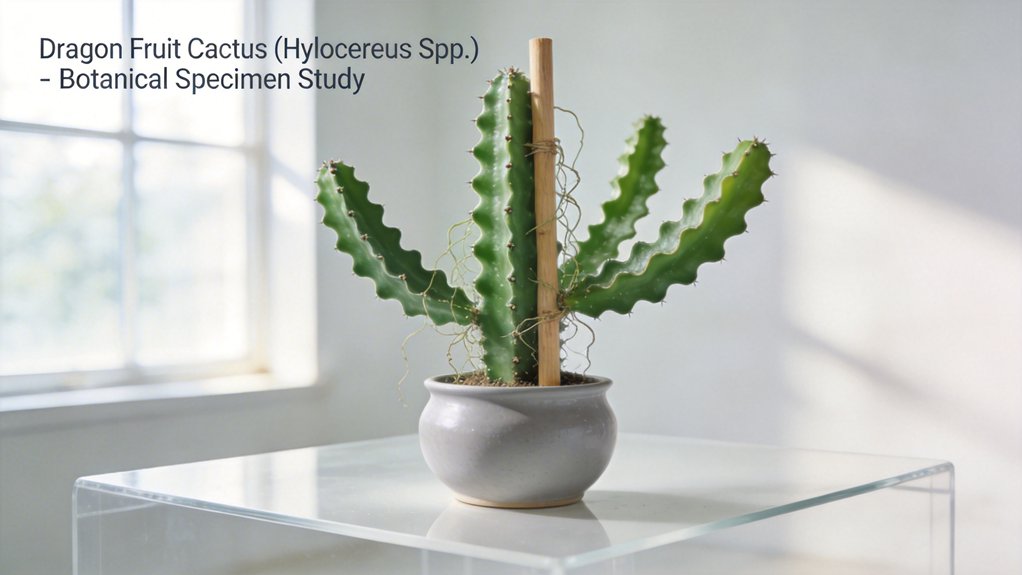
Dragon Fruit Cactus (Hylocereus spp.): Complete Growing And Care Guide For Fast Growth, Blooms, And Fruit
Dragon fruit cactus is built for warm forests, not deserts. It climbs like a vine, grips surfaces with aerial roots, and grows fast when conditions are steady. Many people fail with it because they treat it like a slow, dry-climate cactus.
This plant also rewards structure. Without a strong support system, stems sprawl, snap, and shade themselves. When the canopy gets crowded, flowering drops, and disease risk rises.
Hylocereus spp. Basics: Species, Names, And What You’re Actually Growing
“Dragon fruit cactus” is a common name used for several climbing cactus species grown for edible fruit. In gardening, you will still see Hylocereus used often. In modern botanical references, many of these plants are treated within Selenicereus. Royal Botanic Gardens, Kew lists Selenicereus undatus as an accepted name, with Hylocereus undatus as a synonym.
For home growers, the name change matters less than the growth habit. These are climbing, succulent, often epiphytic or hemi-epiphytic cacti that perform best with warmth, sun, airflow, and drainage.
Hylocereus undatus Vs. Hylocereus costaricensis: White Flesh Vs. Red Flesh Pitaya
White-fleshed types are commonly linked to Selenicereus undatus in current references. They tend to be widely cultivated and often show strong vigor in warm climates.
Red-fleshed pitaya is often associated with Hylocereus costaricensis in horticulture. In practice, cultivar identity can be messy because names get reused and plants are shared as cuttings. The key takeaway is practical: different cultivars can vary in fertility, bloom timing, and fruit set, so having more than one type can improve results when self-incompatibility is a factor.
Quick Reference Care Routine: Weekly, Monthly, And Seasonal Checklist For Busy Growers
Use this checklist to stay consistent without over-managing the plant:
- Check soil moisture before watering, and only water when the top layer has dried.
- Inspect stems for pests and remove early infestations before they spread.
- Tie and guide new growth upward, and remove low shoots that steal energy.
- Prune crowded canopy sections to restore light and airflow after harvest.
- Hand-pollinate at night if flowers open, but fruit set stays low.
Yellow Dragon Fruit Types: Key Differences In Growth And Flavor
Yellow dragon fruit is popular for its intense sweetness and distinct skin. Many yellow types have different spine behavior and ripening cues than red-skinned types, and they can feel “slower” in cool weather.
Expect ripening signals to differ. Yellow fruit often looks ready before the inside fully sweetens, so timing matters. Cultivar differences are large, so use repeatable cues like slight softness and easy separation at harvest rather than calendar days.
Selenicereus Vs. Hylocereus: Updated Classification And What Gardeners Should Know
If you see Selenicereus undatus on a plant label, it is not a different crop. It reflects the updated classification used by major plant databases. Kew lists Selenicereus undatus as accepted and notes its publication under that name in 2017.
This update does not change how you grow it. What still matters is heat, sun, drainage, trellising, and good canopy management.
Natural Habitat And Growth Habit: Epiphytic, Climbing Cactus With Aerial Roots
Dragon fruit cactus behaves like an epiphytic cactus in many settings. It can grow on trees, rocks, or structures, and it climbs using aerial roots.
Those aerial roots are not a sign that the plant needs more water. They are a climbing tool and a stability tool. You can guide them toward your trellis so stems anchor instead of twisting in the wind.
Climate Needs: Tropical Climate Vs. Subtropical Regions And Plant Hardiness Zones
These plants naturally come from warmer parts of the Americas and prefer warm nights and long growing seasons. Kew describes the native range of Selenicereus undatus as Mexico to Honduras.
In subtropical regions, growth can still be strong, but cool snaps can slow stems and delay flowering. The biggest risk is freezing temperatures, which can scar stems and kill young tips. If your winters are mild but cool, focus on microclimate warmth and wind protection.
Light Requirements: Full Sun, Partial Shade, And Heat Stress Signs
Dragon fruit performs best with strong light. Full sun can drive faster growth and better flowering, but extreme heat can cause sunburn on exposed stems. In the hottest months, light afternoon shade can reduce stress without sacrificing bloom potential.
Heat stress often shows as yellowing patches, pale tissue, or corky scars on the sun side. Treat sunburn as a signal to adjust exposure rather than a reason to overwater.
Temperature And Humidity: Ideal Ranges And Cold Protection
Warm temperatures support growth, bloom, and fruit development. When nights stay warm, the plant maintains momentum. When nights turn cool, stems harden and growth slows.
Cold protection is mostly about prevention. Use a warm wall, avoid open wind corridors, and protect container plants by moving them under cover during cold nights. Damage is harder to reverse than to avoid.
Choosing A Planting Site: Wind, Airflow, And Space Planning For Mature Vines
Choose a site where you can build a trellis that will not lean over time. Mature canopies get heavy, and wet stems add weight quickly. Poor placement is a long-term problem because moving an established plant can break stems and delay fruiting.
Airflow matters as much as the sun. A canopy that stays damp and crowded is more likely to develop rot and fungal issues. UF/IFAS emphasizes selective removal and training to reduce crowding and breakage.
Best Soil For Dragon Fruit Cactus: Drainage, Soil Aeration, And Organic Matter
Drainage is the foundation of root health. UF/IFAS notes pitaya adapts to many soils if they are well-drained and performs well where organic matter is high, or manure is added.
Soil aeration is equally important. A mix that stays soggy limits oxygen, slows root function, and increases rot risk. Aim for a structure that drains fast but does not dry to dust within hours.
Ideal Soil pH And How To Correct It Safely Over Time
Dragon fruit can tolerate a range, but extreme alkalinity can trigger micronutrient problems. UF/IFAS notes minor element deficiencies may appear in high-pH soils.
Correct pH slowly. Use organic matter, avoid heavy lime additions unless a soil test shows a need, and address deficiencies with targeted micronutrients rather than random fertilizer increases.
Potting Mix Recipes For Containers: Fast-Draining Media That Still Holds Nutrients
Containers are often easier because you control drainage. The goal is a chunky, fast-draining mix with enough organic content to feed roots. Compost can help, but too much fine compost can collapse the mix over time.
A good container mix keeps its structure after repeated watering. If it turns muddy, roots will suffer even if you water “correctly.”
Container Growing: Dragon Fruit Cactus In Pots Without Stunting Growth
Pots work well when the container is large, and the support is stable. The main limitation is root volume and heat swings. A small pot dries too fast, forcing frequent watering, and increasing salt buildup from fertilizer.
A large pot also stabilizes a trellis post. That stability reduces micro-damage at the base, which can become entry points for rot.
Pot Size, Drainage Holes, And When To Repot A Pitaya Plant
Use a pot that fits the trellis plan, not just the cutting. Multiple drainage holes are essential because standing water is more dangerous than brief dryness.
Repot when roots circle heavily, when water runs straight through without wetting the mix, or when growth slows despite good light and feeding. Repotting is also a chance to refresh the structure and reduce compaction.
Watering Strategy: Deep Watering, Dry-Down Cycles, And Root Health
Water deeply, then let the upper layer dry before watering again. This approach supports roots without keeping them oxygen-starved. University of Guam extension guidance highlights irrigation as a key management area and ties it to pruning and canopy health in trellis systems.
Overwatering is the most common mistake. Rot often starts quietly, then shows up as soft stem bases or yellowing that does not improve with more water.
Seasonal Watering Adjustments: Summer Growth Vs. Cooler-Season Slowdown
In hot weather, water demand rises because stems grow faster and evaporate more. In cooler months, growth slows, and water use drops sharply, especially in containers.
Match watering to growth, not to the calendar. A plant that is not actively pushing new stems does not need frequent watering.
Fertilizing For Stems, Flowers, And Fruit: Balanced Feeding Without Overdoing Nitrogen
Nitrogen builds stems, but too much nitrogen can delay flowering and create soft growth. Balanced feeding supports steady structure, then shifts toward bloom and fruit support as the canopy matures.
If you only chase rapid green growth, you may get a huge vine with few flowers. Focus on canopy balance and light penetration, then fertilize to support reproductive growth.
Organic Feeding Options: Compost, Aged Manure, And Slow-Release Additions
Organic matter improves soil structure and provides a slower nutrient release. UF/IFAS notes pitaya thrives in soils high in organic matter or where manure is added.
Use well-aged inputs. Fresh manure can burn roots and increase salt stress, especially in pots.
Micronutrients And Common Deficiencies: Yellowing, Weak Growth, And Poor Flowering
High pH and low organic matter increase the risk of micronutrient deficiency. Symptoms often look like pale new growth, weak tips, or reduced vigor, even when you fertilize.
Correct deficiencies with targeted micronutrients and better soil conditions. Do not respond by doubling fertilizer, which can worsen salt buildup and root stress.
Trellis Planning: Why A Cactus Trellis Support Is Non-Negotiable
Dragon fruit is a tropical climbing cactus that becomes heavy. A weak trellis will fail at the worst time, often when the canopy is full of water or fruit.
Extension guidance commonly recommends training up a post to a canopy top for manageable production systems. Trellis planning is not optional if fruiting is the goal.
Trellising System Designs: Post-And-Frame, T-Top, And Wall/Arbor Training
A post-and-top design supports a “tree-like” canopy where stems hang down and flower along the edges. A T-top increases the canopy spread and can improve light distribution if managed well.
Wall or arbor training can work for small spaces, but it needs strict pruning to prevent shading. The best design is the one you can maintain without fear of collapse.
Cactus Trellis Materials: Wood Vs. Metal Vs. Concrete And Long-Term Stability
Concrete and galvanized metal often last longer than untreated wood, especially in humid climates. Wood can work if it is durable and protected, but it may rot at the soil line.
Choose materials based on your climate and budget, then overbuild. Trellis failure can set a plant back for a full season.
Training A Tropical Climbing Cactus: Tying, Guiding, And Managing Aerial Roots
Train one to a few main stems up the post in the first stage. Tie loosely to prevent girdling as stems expand. Remove low side shoots early so energy goes upward, and the trunk stays strong.
As the plant reaches the top, allow branching to form the canopy. This is where fruiting sites develop, so your goal becomes spacing, airflow, and light.
How To Propagate Dragon Fruit Cactus: Stem Cuttings That Root Reliably
Stem cuttings are the standard way to propagate because they preserve cultivar traits and shorten the time to fruit. Cutting-grown plants often fruit earlier than seed-grown plants under similar care.
Choose mature, healthy stems. Avoid soft, thin growth because it rots more easily and stores fewer reserves.
Selecting Cuttings: Mature Stem Traits, Thickness, And Disease-Free Signals
Select stems that are firm, fully green, and free of mushy spots or dark lesions. A thicker cutting usually stores more water and carbohydrates, which supports rooting.
Inspect for pests like mealybugs tucked into ridges. Starting clean reduces problems later.
Curing And Callusing Cuttings: Preventing Rot Before Planting
Let the cut ends dry and callus before planting. This step seals tissue and reduces infection risk. The callus should feel dry and slightly hardened.
Planting a fresh, wet cut is a common cause of base rot. Patience at this stage saves weeks of recovery.
Rooting Methods: Water Vs. Soil Propagation And When Each Works Best
Soil rooting is often simpler because roots adapt to the final medium. Water rooting can work, but roots formed in water may struggle when moved to soil.
If you use water, transition carefully and avoid keeping the soil constantly wet. The goal is oxygen around new roots.
Planting Cuttings Correctly: Depth, Orientation, And Early Watering Rules
Plant with the correct orientation. A reversed cutting may root poorly or rot. Insert only enough depth to stabilize the cutting, then support it to prevent wobble.
Water lightly at first. Overwatering before roots form is a fast path to rot.
Growth Timeline: What To Expect In The First 30, 60, And 120 Days
In the first month, your goal is rooting and stability. You may see little top growth, which is normal if roots are developing.
By two to four months, a healthy cutting should show new tips and thicker growth if light and warmth are strong. Growth speed rises sharply once the plant has both roots and a stable trellis path.
Pruning For Structure: How To Prune Pitaya Plant For Strength And Yield
Pruning is how you control the canopy and direct flowering. University of Guam extension notes initial pruning to encourage upward growth in the first year, followed by selective pruning for airflow as plants mature.
Pruning is also linked to production systems in research. Trellis-grown plants respond to pruning levels, and canopy density affects efficiency and fruit quality.
Pruning For Light And Airflow: Reducing Disease And Pest Pressure Naturally
Crowded canopies trap humidity and shade flowering sites. UF/IFAS advises selective removal and training to prevent crowding and breakage, and notes pruning may be needed one to three times per year.
Remove weak, damaged, and inward-growing stems first. Keep strong stems with space to hang and receive light.
Flowering Cycle Explained: When Dragon Fruit Cactus Bloom And Why It’s At Night
Dragon fruit is a night-blooming cactus. Flowers open in the evening and close by morning, which shapes pollination timing and how you manage fruit set. (PMC)
Bloom timing can shift with climate and rain patterns. Research in subtropical conditions shows that flowering can vary by year and may respond to early summer rains and microclimate.
Dragon Fruit Flowers: Bud Development, Bloom Timing, And What “One Night Only” Means
Bud development takes time. Buds swell, elongate, and then open rapidly when conditions align. Once open, the flower is usually receptive for a limited window.
Because the bloom window is short, missed pollination can mean missed fruit. Planning matters if your cultivar needs cross-pollination.
Pollinators And Pollination: Moths, Bees, And Practical Garden Support
Night-opening flowers attract night-active pollinators. In many regions, moths and bats are key, and daytime insects may visit as flowers close.
Natural pollination can be unreliable, especially for varieties with fertility limits. If fruit set is poor, do not assume it is a nutrient issue first. Pollination is often the missing link.
Is Dragon Fruit Cactus Self Pollinating? How To Tell If You Need Cross-Pollination
Some cultivars are self-compatible, and others are self-incompatible. A recent study found that one white-fleshed variety was self-compatible, but cross-pollination still improved fruit weight.
If you get many flowers but few fruits, suspect pollination first. If hand pollination with the same flower’s pollen fails repeatedly, you may need pollen from a different cultivar that blooms the same night.
Hand Pollination Step-By-Step: Boosting Fruit Set When Pollinators Are Limited
Hand pollination is effective but labor-heavy because it happens at night. Research and grower practice both highlight that the process can be costly and time-consuming in production settings.
Use a clean, soft brush or collect pollen onto a small container, then transfer it to the stigma while the flower is fully open. If you suspect cross-pollination is needed, store pollen short-term and label cultivars so you can repeat what works.
Why Buds Drop: Stress Triggers (Heat, Water Swings, Nutrient Imbalance)
Bud drop is often a stress response. Rapid heat spikes, dry-to-wet swings, and sudden fertilizer changes can trigger it. Poor canopy airflow can also contribute because buds are sensitive to humid, stagnant conditions.
Fix the environment before adding more inputs. Stable watering, balanced feeding, and a pruned canopy often reduce bud loss more than any single supplement.
How Long Does Dragon Fruit Take To Fruit? Realistic Timelines By Method And Conditions
Cuttings can fruit earlier than seed-grown plants because they start with mature tissue. In strong conditions, some cuttings may flower within a year, while others take longer, depending on cultivar and management.
The most reliable path is steady growth to the trellis top, then controlled branching. If you rush with heavy fertilizer but skip structure, you often delay fruiting.
From Flower To Harvest: Fruit Development Stages And What Changes Each Week
After successful pollination, the ovary swells and the fruit begins to size up. Growth is fastest in warm weather with steady moisture. Stress during this stage can reduce fruit size and cause uneven ripening.
Protect developing fruit from physical damage. Broken stems and shifting trellises can drop fruit before it ripens.
Harvest Timing: Color, Bract Changes, And Ripeness Signals By Fruit Type
Color change is a main cue for red-skinned fruits, but it is not the only cue. Many growers watch the “wings” or bracts as they begin to soften or slightly dry. General harvesting guidance notes: fruit is often ready when flaps begin to wilt and the fruit detaches more easily.
Harvest too early, and the flavor is thin. Harvest too late, and the texture can soften too far, especially in hot weather.
White Flesh Dragon Fruit Vs. Red Flesh Pitaya: Ripeness Cues And Taste Differences
White-fleshed fruit often tastes mild and refreshing, while red-fleshed types can be richer and more aromatic. Ripeness cues are similar, but red-fleshed fruit may show deeper internal color even before peak sweetness, so rely on firmness and ease of separation.
If you grow multiple cultivars, keep notes. Your climate can shift the “best day” window by several days.
Yellow Dragon Fruit Harvest Cues: Avoiding Underripe Or Overripe Fruit
Yellow fruit can be tricky because the skin looks ripe early. Wait for a slight give under gentle pressure and watch for easier release from the stem. If you have spines, handle them carefully and use gloves.
Taste is the final judge. Once you dial the timing, yellow types can be among the sweetest options.
Improving Fruit Quality: Size, Sweetness, And Consistency Through Care
Fruit quality comes from balanced plant energy. A canopy that is too dense spreads resources thin, while a canopy that is too sparse may not produce enough flowers. Research on pruning and canopy management supports the idea that structure and density influence productivity and fruit outcomes in trellis systems.
Keep moisture steady during fruit fill. Large swings can reduce size and increase cracking risk in some conditions.
Common Pests Of Dragon Fruit Cactus: Identification And Early Warning Signs
Mealybugs, scale insects, and ants are common issues, especially in sheltered canopies. Early signs include sticky residue, cottony clusters in stem ridges, and sooty mold.
Pests often surge when airflow is poor and stems overlap. Good pruning reduces hiding places and makes control easier.
Integrated Pest Management: Safer Controls Before Reaching For Strong Sprays
Start with physical control and sanitation. Prune and remove heavily infested stems, then wash remaining stems with water where practical. Use targeted, low-toxicity treatments when needed, and avoid spraying during bloom windows that depend on pollinators.
A clean canopy is easier to manage than a chemical routine. Prevention is usually simpler than rescue.
Common Diseases And Rot Issues: Causes, Prevention, And Recovery Steps
Stem rot is often linked to excess moisture, poor drainage, and wounds. UF/IFAS notes that cuts may be treated to reduce stem rot incidence, highlighting that pruning wounds can be disease entry points.
Prevention starts with drainage, airflow, and tool hygiene. If rot appears, cut back to clean tissue and let the wound dry before conditions turn wet again.
Sunburn, Scarring, And Stem Damage: When It’s Cosmetic Vs. A Real Problem
Surface scarring from sun or wind can be cosmetic if tissue stays firm and green around the area. Problems begin when scars crack deeply, expose wet tissue, or sit near the base where infection spreads faster.
Support the plant to reduce movement and rubbing. Many injuries happen because stems sway and scrape on rough trellis edges.
Overwatering Vs. Underwatering: Symptom Checklist And Quick Fixes
Overwatering often shows as soft, translucent tissue and a weak base. Underwatering shows as wrinkling, dull color, and slowed tip growth. The trick is that both can cause yellowing, so check the soil before guessing.
If the soil is wet and the plant looks stressed, stop watering and improve airflow. If the soil is dry and the stems are wrinkled, water deeply and then return to a dry-down cycle.
Troubleshooting Poor Growth: Light, Trellis Setup, Soil, And Feeding Mistakes
Poor growth is usually a systems issue, not a single missing product. Low light slows everything. Weak trellises cause breakage and repeated setbacks. Compacted soil blocks roots, even when you fertilize.
Correct one factor at a time. When you fix light and structure, many “mystery problems” disappear.
Winter And Cold-Season Care: Protecting Vines, Roots, And Bud Potential
Cold slows growth and can damage tips. Your goal is to keep stems dry, intact, and stable until warmth returns. Avoid heavy feeding in cool months because unused nutrients can build up as salts.
Containers give you flexibility. Move them under shelter during cold nights, and keep watering minimally while growth is slow.
Growing Dragon Fruit At Home Indoors: When It Works And When It Doesn’t
Indoors can work if you provide intense light and space for a trellis. Without strong light, stems become thin and weak, and flowering becomes unlikely.
A bright window is rarely enough for fruiting. If you want fruit indoors, treat it like a high-light crop with a dedicated grow setup.
Long-Term Maintenance: Annual Pruning, Trellis Checks, And Rejuvenating Old Plants
Long-term success depends on routine pruning and trellis checks. Tight ties can cut into stems over time, and leaning posts worsen each season. Replace worn supports before they fail.
Old plants can be rejuvenated by removing weak wood, keeping strong hanging stems, and resetting canopy spacing. Think of it as rebuilding a productive structure rather than letting the canopy turn into a tangled mass.
Safety And Handling: Spines, Skin Irritation, And Clean Cutting Practices
Some types have spines, and even “spineless” stems can irritate skin through fine bristles. Wear gloves for pruning and harvesting. Use clean tools and avoid spreading disease through sap.
Tool sanitation is simple insurance. Clean cuts heal faster and reduce infection risk.